7 Ways to Increase the Efficiency of Your Construction Fleet
Published
Reading time
12 minutes
Blogs
The seven main ways to increase the efficiency of your construction fleet are:
Use telematics and GPS tracking to keep everything under control.
Keep vehicle maintenance up to date..
Implement a fuel monitoring solution.
Offer your drivers ongoing training.
Plan better routes between sites.
Match the size of the fleet to your real needs.
Regularly analyse key performance indicators.
Fleet efficiency is essential for construction companies in Mozambique, as it directly affects project deadlines, safety and operating costs. Without a solid strategy and the right technology, your business faces challenges such as high fuel costs, unexpected downtime and poor driving behaviour, which compromise the health of your vehicles and equipment.
With the growth of the construction sector in Mozambique, driven by infrastructure, housing and energy projects, companies are increasingly investing in telematics, IoT sensors and mobile platforms to improve fleet monitoring. To stay ahead of the competition, you need an effective approach — which is why we present the seven ways to improve your construction fleet operations.
Key takeaways:
Telematics and GPS tracking let you know where your vehicles and equipment are, improving productivity
Regular maintenance and fleet system alerts prevent breakdowns and extend the life of your vehicles
Fuel management and driver training save money, reduce waste and improve safety
Route planning, right-sizing the fleet and performance analysis keep the fleet running efficiently
7 Key strategies to improve construction fleet efficiency
The 7 key strategies to improve the efficiency of your construction fleet are:
Invest in telematics and GPS tracking
Regular maintenance
Implement a fuel management system
Driver training
Route planning
Fleet size optimisation
KPI analysis
Together, these strategies help to reduce costs, minimise downtime and ensure your construction fleet performs at its best.
Below is a summary of each point:
1. Implement telematics and GPS tracking
Telematics features have become essential in construction fleet management, as most companies already make data-driven decisions to increase operational efficiency. To keep pace with or stay ahead of the competition in Mozambique, you also need to invest in telematics technology.
With telematics, you can monitor the location of your vehicles, equipment, machinery and other tools. This helps to prevent theft, a real problem on sites in Maputo, Matola and other cities… and makes it easier to locate your resources. You will also be able to see how productive your employees are, such as whether equipment is actually working or just idling.
2. Schedule regular maintenance
Your fleet is only as good as its maintenance, and with telematics technology, you can digitise maintenance-related tasks. To reduce unexpected downtime and increase efficiency, use the maintenance features of your fleet management platform. Set up reminders with the service intervals recommended by the manufacturer, so that you can schedule services in advance and plan operations better.
Through telematics, you will also receive early alerts of maintenance needs and identify potential mechanical failures before they occur. Fix problems before they cause breakdowns: this reduces downtime, increases safety and extends the life of your vehicles.
3. Implement a fuel management system
Make sure you add a fuel management system to your fleet software package, to monitor consumption per vehicle and piece of equipment. A fuel management system is made up of hardware and software tools that help you use fuel more efficiently and reduce costs. In Mozambique, where fuel prices are regulated but fuel diversion and siphoning are frequent problems on sites, this system is especially important.
With fuel level sensors, you can quickly detect sudden drops in tanks, a sign of theft or a leak. The system also makes it easier to monitor fuel cards and can flag fraud.
4. Train drivers for greater efficiency
Drivers perform better when they receive regular training. Hold regular training sessions to educate drivers about behaviours that affect fuel costs and vehicle health. Fleet operators should be trained in defensive driving, vehicle safety checks, equipment handling, the rules of the road and the use of fleet management software. Better driver behaviour improves safety and compliance, reduces operating costs and lowers the number of accidents.
5. Improve job and route planning between sites
Poor planning between depots, suppliers and construction sites can result in wasted time and fuel. In Mozambique, where road conditions vary significantly, route planning is even more critical.
Use route optimisation software to plan stops better, so that your vehicles arrive on time and complete the job as quickly as possible without compromising service quality. Better route planning also reduces last-minute changes, which can disrupt other jobs, increase fuel consumption and put drivers under stress.
6. Optimise fleet size and equipment allocation
Right-sizing the fleet means making sure the number of vehicles and pieces of equipment matches your real operational needs. It is important to assess the size of your fleet regularly. You may find that your vehicles/equipment are overworked and worn out because there are too few of them, or that you have more than you need and should downsize and reallocate assets to save costs.
7. Monitor and analyse key performance indicators
Measuring your fleet's performance requires you to regularly check important metrics such as:
Total Cost of Ownership (TCO)
Fuel cost per route
Vehicle utilisation rate
Maintenance costs
Downtime rate
Driver behaviour
Regular analysis helps to identify inefficiencies and is easy when you have fleet management software, as it provides a detailed analysis of the various aspects of the operation.
Explore our fleet management solutions to take your construction fleet to the next level
Our fleet management solutions take your construction fleet to the next level, providing detailed insights into your operations and protecting your assets. We offer solutions such as GPS trackers, preventive maintenance alerts and a fuel monitoring system. These solutions help to reduce expenses, improve productivity and, as a result, make you more efficient.
Real-time GPS tracking
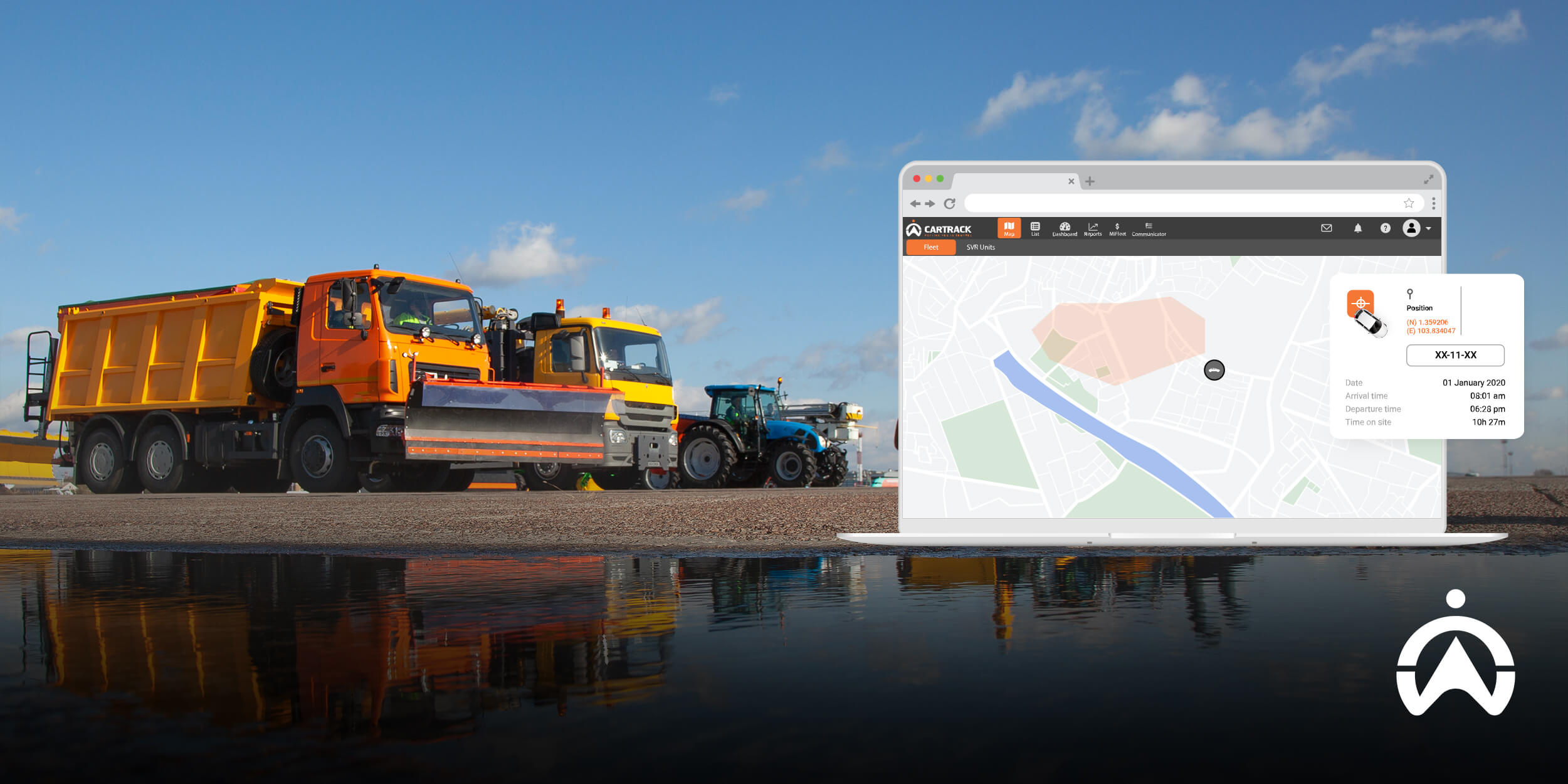
Always know where your vehicles and machinery are with our GPS trackers. This makes it harder for your assets to go missing and ensures you can see what drivers are doing and whether they arrive on time. Our GPS trackers have telematics capabilities, which means you can also see when drivers are idling for too long or engaging in risky behaviour. You will receive reports on these behaviours so that you can act quickly.
Non-powered asset tracking
Some of your assets have no power source and are therefore not compatible with conventional GPS tracking devices. For these, we have non-powered asset trackers. They can be used to monitor trailers, storage containers and other site equipment. They help to protect your assets against possible theft and reduce the time your team spends looking for equipment on site.
We have three main types of non-powered asset trackers:
Asset Tracker
Track & Go
TAG
How they work:
The Asset Tracker can be installed on non-powered assets, such as trailers, purely to locate them. It lasts up to four years without needing to be recharged. It provides up to two updates a day, ideal for assets that do not need constant monitoring.
The Track & Go is exactly what the name suggests: a portable magnetic tracking device that can easily be moved from one asset to another. It provides not only location data, but also detailed telematics data on how operators use it. It gives real-time updates and needs occasional recharging. Ideal for tracking rented assets — you can remove it once the project is over.
The TAG is another permanently installed device that provides location data by radius. You can set a circle (radius) at any point on the map and see where the asset is within that area, ideal for tracking industrial equipment on large sites. It is portable, does not need recharging and provides frequent updates, mainly in urban areas.
Geofencing (Virtual Fences)
Our geofencing feature lets you create virtual boundaries and receive alerts when drivers enter or leave those areas. You can use this to make sure your vehicles or equipment do not leave the site without authorisation. This feature can also be used to check whether vehicles arrive at the various sites on time and how long they take to get there.
Power Take-Off (PTO) sensors
The Power Take-Off sensors from Cartrack are IoT devices that monitor engine activity to help you see when your machinery is being used efficiently. With this, you can tell productive idling from unproductive idling, helping to save on fuel costs and improve operations.
Preventive maintenance
Our preventive maintenance solution provides features that help you maintain your vehicles and machinery better. You can add the recommended service dates to our platform and receive reminders as the date approaches. That way, you won't skip any maintenance, which improves the life of your vehicles and lets you plan operations with fewer unexpected interruptions.
Through our maintenance platform, you can also create digital vehicle inspection checklists for drivers to use before and after trips. The feedback from these checklists will help you identify which vehicles have worn parts that need repairing or replacing, reducing the chances of disruption from unexpected breakdowns.
Another great benefit of our preventive maintenance software is that it can provide early alerts of engine faults, worn brakes and the need for an oil change. The system analyses certain components, allowing mechanical failures to be detected in advance.
Fuel management
Fuel is one of the biggest contributors to high operating costs, and with our fuel management system, you will make significant savings. We have several solutions that ensure close monitoring of fuel consumption, such as MiFleet and Fuel Probes.
MiFleet is a cost management platform that helps you manage the expenses of various aspects of your fleet, including fuel. This feature monitors distances travelled, fuel receipts, litres and location — and flags suspicious activity that may indicate theft or fraud.
The fuel probes are sensors installed in vehicle tanks or in site tanks to measure fuel levels in real time. You will receive alerts of sudden drops, which may indicate fuel siphoning or a leak. These tools help to monitor fuel use closely and detect theft quickly.
Driver management
The way your drivers treat vehicles and equipment directly affects the health and efficiency of your fleet. For this, we have driver management solutions such as DID tags and fleet cameras.
Our Driver Identification (DID) tags help to maintain compliance and to know who is driving. You can assign each tag to a specific vehicle or machine that the driver is qualified for. If someone tries to operate a vehicle or machine they are not qualified for, the vehicle will not start.
Our AI Multi Vision camera solution ensures you see everything that happens with your fleet in real time. You can install up to eight cameras in and around your vehicles to monitor operations and live-stream from anywhere at any time. Our on-board cameras (dashcam) also identify distracted driving such as drowsiness, mobile phone use and smoking, and sound audible alerts so that drivers can correct their behaviour immediately.
Your trusted solution for construction fleet efficiency | Cartrack Mozambique
At Cartrack, we offer our services to fleets of different types, including those in the construction sector in Mozambique. Over the years, we have helped many companies transform their fleet operations through our sector-specific features. With us, you are guaranteed smooth operations and optimum efficiency. Contact us and start seeing the difference!
FAQs
What factors contribute to successful fleet operations?
The factors that contribute to successful fleet operations are safety and compliance, driver management and proper cost analysis. This is done effectively through fleet management software, which provides smart solutions to better manage the various aspects of your fleet's operation.
What skills are needed to be a fleet manager?
To become a fleet manager, you need a combination of leadership skills, financial skills, effective communication, technical knowledge and problem-solving ability. You need to lead, communicate effectively with your drivers and motivate them around a shared vision, all while managing costs and identifying inefficiencies.
What is the biggest challenge in fleet management in Mozambique?
The biggest challenge in fleet management in Mozambique is managing rising operating costs caused by factors such as fuel, maintenance and asset theft. You can overcome this challenge by investing in a fleet management system such as Cartrack's, which gives you more visibility over your fleet's operations and helps to identify what needs to be improved to reduce costs.
Other articles for you
Food Transport Facts and What You Need to Know When Managing Your Fleet
Blogs
11 minute read •
Important facts about food transport in fleet management: keeping perishable goods fresh in transit directly affects your profits — and mixing food loads is a serious mistake. Other facts include the food distribution regulations in force in Mozambique, the challenges of electricity supply and the […]
How to Manage Your Light Commercial Vehicles (LCVs) Effectively with Fleet Management Software
Blogs
12 minute read •
To manage your light commercial vehicles effectively with fleet software, you should invest in a platform that directly addresses the biggest challenges LCVs face. LCV fleets deal with unique vulnerabilities because of their frequent trips. Wear and tear, wasted fuel, unexpected downtime and more are some of the main concerns. LCVs are […]
Advanced Vehicle Tracking System with Cartrack: What Sets Us Apart
Blogs
8 minute read •
An advanced vehicle tracking system goes far beyond showing your vehicle's position on a map. What really sets an advanced platform apart are the extra security, response and control features. Cartrack combines GPS tracking, telematics and round-the-clock support to offer real protection and not just location. In the Mozambican […]
 South Africa
 Botswana
 Kenya
 Malawi
 Namibia
 Nigeria
 Swaziland
 Tanzania
 Zimbabwe
 Hong Kong
 Indonesia
 Singapore
 Malaysia
 Philippines
 Thailand
 New Zealand
 Vietnam
 Poland
 Portugal
 Spain
 United Arab Emirates

 PT