Is your fleet equipped to handle last-mile deliveries? No, this doesn’t refer to a literal mile; it is the last stage of fleet deliveries, focused on getting goods to customers.
What exactly does this “final lap” mean, and how can your fleet make sure it stays efficient on it?
Let’s find out.
In this article, you will:
- Learn what last-mile delivery is
- Dig into the different delivery stages in the supply chain
- Explore how the e-commerce sector grew with the restrictions of the COVID-19 pandemic
- Discover which challenges are faced in last-mile delivery
- Discover how the solutions from Cartrack Mozambique are the key to profitable deliveries
What is last-mile delivery?
Last-mile delivery, also known as the “final mile”, is the final part of the supply chain, where products move from a distribution centre to their final destination, the end consumer’s home or business. This stage, which is often seen as the most critical and challenging aspect of logistics, involves the actual delivery of goods to their final destinations, requiring a focus on efficiency, speed and profitability to fulfil customer orders promptly while minimising operating expenses.
Despite the relatively short distance covered compared with other stages of the supply chain, last-mile delivery has its complexities. Its challenges stem from the transfer of goods from transport hubs or distribution centres to customers’ homes, without the same level of control, consistency and scale as the earlier stages of the logistics process. While the wider logistics process involves a complex network of rail, sea, road and air transport, the last mile presents unique difficulties that make it a crucial and complex part of the whole supply chain.
To gain a comprehensive understanding of last-mile delivery, we need to look at the whole supply chain and its various stages.
The supply chain explained
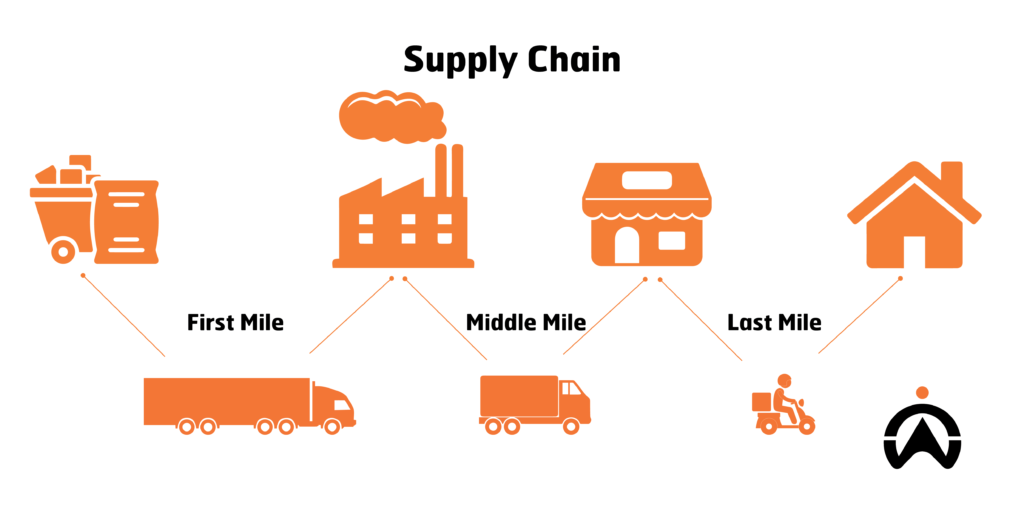
A supply chain is the network of individuals, activities and technology involved in creating and selling a product. From the delivery of materials purchased from suppliers to the delivery of a finished product to customers, the supply chain is a vital part of any business. The supply chain process involves two other main stages that come before final delivery:
- First mile:
First-mile delivery marks the start of the delivery process, covering the initial stage of transporting goods within the supply chain. This stage involves the transport and potential assembly of materials. It is a critical stage where products are sourced, manufactured and transported from their origin to a warehouse or distribution centre. This logistics process is hugely important, especially in the age of e-commerce, where customer expectations of fast and reliable delivery services have risen.
An example of first-mile delivery in the retail sector is the shipping of bulk orders of newly ordered garments from a factory to a regional distribution centre, marking the start of the supply chain.
- Middle Mile:
Middle-mile delivery plays a crucial role as a vital link between the first and last stages of delivery, involving the transport of goods from regional distribution centres to sorting facilities. This critical stage normally involves the movement of goods from ports or production facilities to warehouses or regional distribution centres.
In contrast to first-mile delivery, which deals with individual producers or manufacturers, and last-mile delivery, which focuses on delivering the product to end customers, middle-mile delivery covers the transport of goods between established warehouses and shipping points. This transport involves moving goods over longer distances, potentially crossing several regions or international borders.
To do this effectively, businesses may need to use several modes of transport, such as trucks or planes, making it a complex and challenging aspect of the overall logistics journey.
An example of middle-mile delivery in the retail sector is the shipping of bulk clothing orders from the regional distribution centre to a central sorting facility, where the items are organised and then sent to various retail stores in different locations.
Final delivery trends in the rise of e-commerce after the COVID-19 pandemic
The COVID-19 pandemic accelerated the rise of e-commerce, making it an essential service for buying a wide variety of goods. With physical shops closing temporarily or operating under restrictions, businesses were forced to adapt to the changing landscape or run at a loss.
Lockdowns, social distancing measures and concerns about face-to-face interactions due to the pandemic led people to opt for online shopping as a safer and more convenient alternative.
The emergence of new customer and business expectations
This rise in e-commerce has had a significant impact on last-mile delivery, resulting in a rise in new customer expectations of the logistics sector. These expectations include:
The essence of e-commerce is maximum convenience for consumers, and its rise has not only affected the way these customers interact with businesses, but also what they expect from them.
Let’s take a look at three of the most common expectations that have risen:
- Increased purchasing demand:
Online shopping has made life incredibly convenient, allowing you to order everything you need with a tap on a phone or a click on a computer. This convenience has led to a significant increase in demand for a variety of products. As more people shop, we see a growing number of parcels that need to be delivered to homes. While this increase in demand is fantastic, as it translates directly into higher profits, it also means that a business needs to put more strategies in place to make sure it doesn’t become overloaded and under-equipped.
- Increased demand for fast and reliable deliveries:
The convenience of online shopping has raised customer expectations of fast, reliable and cost-effective deliveries, so much so that many businesses offer same-day or next-day delivery. This puts pressure on the logistics sector to meet these demands. While the average customer’s willingness to wait for a delivery may vary, it is widely known that customers want to receive their goods as quickly as possible. One example of this is seen in the retail sector, where 41% of global customers expect delivery within 24 hours and 6 in 10 customers expect delivery within three days.
- Real-time tracking and visibility:
One of the biggest attractions of online shopping is that customers can know exactly where their deliveries are. This insight is boosted by the use of advanced technology, which has made it possible for businesses to gain full visibility of all their operations. This also applies to professionals in the logistics sector. Customers want to know exactly where the delivery is and how long it will take to reach their door.
What will the challenges be if customer and business delivery expectations aren’t met?
The success of a business and its ability to make efficient deliveries depends on its ability to meet the expectations above because, if they aren’t prioritised, they can turn into challenges.
Let’s look at some of the challenges faced in the last-mile stage of deliveries:
- Lack of visibility:
A lack of visibility in the last-mile stage of deliveries refers to limited or insufficient information about the status and location of your delivery while it is in transit. This makes it difficult to identify and resolve possible problems that may arise during the delivery of a product. This is directly linked to the next challenge, which is inadequate route planning.
- Inadequate route planning:
Unpredictable conditions on the road while deliveries are being made, such as road closures and traffic conditions caused by car accidents or adverse weather, affect last-mile delivery. Poor route planning can contribute to high operating costs because inefficient routes are directly linked to higher fuel and labour expenses. Delivery environments are very complex, including congested urban areas and limited infrastructure, which can make planning and carrying out routes extremely difficult. Failing to plan your route in advance is directly linked to the next challenge, which is late deliveries.
- Late deliveries:
What makes this difficulty dangerous is that it directly affects the customer experience. Late delivery refers to the failure to deliver goods to customers within the expected time. This can happen for several reasons, including inadequate route planning, a lack of delivery route planning, traffic congestion and car accidents. When there is no fleet visibility, managers can’t see exactly where their vehicles are or how long it will take for deliveries to be completed. This means that dates and times aren’t based on accurate figures and customer commitments turn into a guessing game. Without accurate information, businesses can’t warn customers about possible delays, which increases their frustration and dissatisfaction with the service. Worse still, an increase in late deliveries brings the next challenge: high delivery costs. You are now forced to use more fuel for the delivery you failed to make and/or negotiate discounted rates to keep the customer relationship.
- High delivery costs:
The factors that contribute to high delivery costs in last-mile delivery include rising customer demand and expectations, poor route planning, failed deliveries, traffic congestion and rising labour costs. Completing deliveries can be costly because of the fuel consumed when drivers need to travel to and from several delivery addresses. If these costs are consistently high, they can significantly reduce the fleet’s profits. Consistently high delivery costs can lead to a 26% fall in profits over three years, especially if last-mile delivery isn’t optimised.
Breakdown of costs by delivery stage
Having an inefficient delivery system can have a negative impact on your business’s finances, especially because last-mile delivery is the most expensive stage.
Let’s look at the breakdown of costs across the 3 different delivery stages:
First-mile delivery:
Cost: 12% -20% of the total delivery cost
At this initial stage, delivery costs come from transporting raw materials to production or storage. These costs are made up of:
- Transport costs
- Warehouse receiving process
- Quality checks and packaging
- Paperwork and documentation
Middle-mile delivery:
Cost: 25% -35% of the total delivery cost
At this second stage, delivery costs come from transport from production or storage to the distribution centres. These costs are made up of:
- Transport and distribution costs
- Storage costs
- Route optimisation
Last-mile delivery:
Cost: 41% -53% of the total delivery cost
At this third and final stage, delivery costs come from the transport that takes the final products to your customers. This includes drivers’ wages, vehicle maintenance and route planning
- Drivers’ wages
- Fuel costs
- Vehicle maintenance
- Route optimisation
The importance of customer experience and satisfaction
Customer experience is one of the most important aspects of final delivery because it has a significant impact on customer satisfaction. Keeping customers happy goes beyond providing them with a great product or service; it’s about how you make them feel. This is a feeling that stays with them and has a long-term impact on the business and its reputation.
A positive customer experience helps you not only to retain customers, but also to encourage brand advocacy. Increasing customer retention rates by just 5% can increase your profits by up to 95%, and 93% of customers are likely to use a business again if they experience good customer service.
This is especially important in today’s digital age, where people can easily find a review of your business, which has a huge impact on the decision whether or not to do business with you. Studies show that 94% of consumers have avoided a business because of negative reviews, meaning these comments and reviews have a strong impact on a business’s reputation.

Making sure your fleet stays at the top of its last-mile delivery game can be a big challenge, but with Cartrack Mozambique, that challenge becomes very easy. The key? It’s our delivery software
Cartrack Delivery is a feature-rich solution specially designed to streamline and optimise delivery operations for fleet managers and drivers. This easy-to-use app serves customers where constant change is a common occurrence, which we see in delivery services. What makes the Cartrack Delivery software so unique is that you don’t need a Cartrack Mozambique tracking device installed in your vehicle to use it; all you need is a smartphone for each driver.
Let’s look at the 6 ways this solution can help you improve your fleet’s deliveries.
- Eliminate excess paperwork:
Simplify your admin and delivery processes at the touch of a button. You can leave notes with special instructions on each job assigned to a driver. Whether it’s a car checklist, declarations and indemnity forms that customers need to review, or creating customer service reports, they can all be included in the job notes so that your driver doesn’t miss a single step. All you need to do is add a relevant URL to the driver notes when creating a job, which will redirect your customer or driver to the document you need to select. Our app makes Proof of Delivery (POD) easy, allowing drivers to take photos of the products being delivered as proof and allowing customers to sign for their parcels electronically. All of this can be documented on the driver’s handheld device, and managers can receive an instant notification that the delivery has been completed.
- Get full visibility of all drivers and trips:
Get access to a real-time view of all the deliveries that need to be made, as well as those that are in progress. Quickly see which of your drivers are available by looking at their status, which shows whether they are online or taking a break. This allows you not only to track drivers, but also to estimate accurately when they will complete a delivery, helping you to schedule future deliveries effectively.
- Keep operations running with offline mode:
Sometimes deliveries are made in areas with little or no coverage. This may seem like a challenge, but with Delivery you can stay on track even when coverage isn’t on your side. Your data can operate in offline mode and, the moment it is back online, all delivery data will be updated or uploaded automatically, ensuring that no job progress is lost.
- Unlock real-time update alerts for your drivers:
Don’t leave your drivers waiting to receive updated information. Delivery ensures that all changes made on the fleet platform are reflected immediately on the driver’s handheld devices. This fast response time helps to ensure that your drivers are told immediately about any changes, keeping them on track in all their jobs and avoiding any frustration at work.
- Optimise your delivery routes:
Reduce trip delays and unnecessary fuel consumption with our route optimisation feature. By analysing distances and travel times, this feature helps you and your drivers identify shorter routes without detours to promote on-time deliveries. This is done by taking real-time road conditions into account, helping drivers to quickly make the best rerouting decisions whenever an unforeseen delay occurs. This means you can make more on-time deliveries, which has a positive impact on customer satisfaction.
- Keep your customers informed:
Don’t leave your customers in the dark; instead, give them a complete view of the delivery of their goods. With Delivery, you can notify your customers by email as soon as the driver starts delivering their goods. If you decide to give your customers full visibility, a link that lets them track the driver and the route they are taking can be sent to them, helping them know exactly where the parcel is, which keeps them in control and increases customer satisfaction.
Make your fleet’s deliveries faster and more profitable with Cartrack Mozambique’s Delivery solution
Whether you want to improve delivery routes, eliminate excess paperwork or get a complete view of your deliveries, Cartrack Mozambique is the solution you’re looking for.
Ready to automate your fleet’s processes today and gain full visibility of task progress so that you can complete them more efficiently?
Contact us and let’s boost your fleet delivery business.
 South Africa
 Botswana
 Kenya
 Malawi
 Namibia
 Nigeria
 Swaziland
 Tanzania
 Zimbabwe
 Hong Kong
 Indonesia
 Singapore
 Malaysia
 Philippines
 Thailand
 New Zealand
 Vietnam
 Poland
 Portugal
 Spain
 United Arab Emirates

 PT