Whether it’s your fleet or your personal vehicle, tyre pressure and tread play a silent but huge role in fuel economy, which is directly linked to fuel consumption and, as a result, to fuel costs.
Tyre pressure is often overlooked — that is, until you find yourself lost and stranded in the middle of nowhere, wondering why your fleet or car used a ridiculous amount of fuel over a relatively short distance, without realising that it may have something to do with the tyre pressure, the tread or both.
In this article, you will:
- Explore the definitions of fuel economy, tyre pressure and tread
- Find out why Mozambicans should care about fuel economy
- Understand the effects of overinflated and underinflated tyres on fuel economy
- Discover the impact of tyre tread and pressure on fuel economy
- Learn how to boost your fuel economy with Cartrack’s innovative solutions
Navigating fuel economy, tyre pressure and tread
According to Forbes, tyre tread contributes to almost a third of a vehicle’s fuel economy.
Learn how to save on fuel costs by educating yourself about fuel economy, tyre pressure and tread below:
Navigating fuel economy
- Defining fuel economy: Fuel economy is the distance a vehicle can cover while running on a fixed amount of fuel. You calculate it by dividing the distance travelled in kilometres by the number of litres in the vehicle. In other words, kilometres per litre (km/l). Many descriptions of this concept rely on the US measure, which translates to mpg or miles per gallon
- Exploring the calculation: The calculation can become more complex. The distance your vehicle or fleet can travel may be influenced by many factors, including:
–Car size
-Driving style
-Use of cruise control
-Load weight
-Terrain
The difference between fuel economy and fuel efficiency
It is essential to define fuel efficiency, as many people assume that fuel efficiency and fuel economy are the same thing.
Fuel economy is specific to distance and, although fuel efficiency is calculated in the same way, that concept is used simply to describe how to use fuel, in general, to make sure as little as possible is used.
Lori Baker’s article for the MIT School of Engineering, “What is the difference between fuel efficiency and fuel economy” clarifies this difference by explaining that fuel economy means miles per gallon. Fuel efficiency, on the other hand, is used to describe how efficiently fuel is used.
Navigating tyre pressure and tread
- Defining tyre pressure: Tyre pressure is the volume of air pumped into a tyre. It helps stabilise vehicles by making sure each tyre has the correct pressure.
- Defining tyre tread: Tyre treads are the grooves or patterns on the outside of tyres. These treads are designed to make sure vehicles have a solid grip on the road surface.
Why ordinary South Africans and businesses should pay attention to fuel economy
Petrol prices have left ordinary South Africans and companies’ fleet management departments drained, demanding innovative ways to deal with fuel consumption. Drawing on the Volvo figures above, it is clear that improving fuel economy is an effective way to cut fuel costs, whether you are a fleet manager or an ordinary car owner.
Find out more about the cost benefits and other advantages of improving your fuel economy below:
Cost benefits expanded
- Fuel costs: as mentioned, improving your fuel economy will reduce fuel costs, as less fuel will be used over certain distances. It also means you can budget to drive longer distances on the same amount of fuel you were using before you improved your fuel economy.
- Maintenance costs: if you cover the same distance on less fuel, there will probably be less wear and tear. This avoids engine maintenance and the associated costs, as well as unnecessary downtime.
- Geographical expansion: When it comes to business, if fleet managers choose to use the extra fuel that would have been used over a previously set distance, the fleet’s delivery reach can be expanded geographically to reach a wider customer base. This expansion means fleet managers can gain more customers and sell more products, improving overall business growth.
- Net profit and disposable income: fleet controllers can also simply increase their net profit, and individuals can use the extra money to pay for basic resources or generate disposable income.
Make and save money while saving the environment
Less fuel consumption means less smoke will be released from the exhaust — this smoke contains harmful gases that have a negative impact on the environment, such as carbon dioxide, nitrogen oxide and carbon monoxide.
Beyond the positive environmental impact, this can lead to a good reputation with current or new customers, partners or other businesses.
Increase fleet productivity
Using less fuel over a given distance lets fleet drivers stop less often to refuel. Fewer stops save time, make deliveries more efficient and improve fleet productivity.
Tyre pressure and grooves and their impact on fuel economy
Tyre pressure affects many parts of your driving experience, from smooth journeys to flat tyres. It affects the safety of the driver and of all the passengers or goods in the vehicle. Overall, vehicle performance gets worse if the tyres are overinflated or underinflated, and high fuel economy is just one of the negative consequences.
Higher fuel use
Increased fuel consumption means a vehicle will cover less distance than it could if there were less fuel consumption, directly influencing fuel economy. Overinflated and underinflated tyres can lead to an increase in fuel consumption.
Underinflated tyres
- Expanding the tyre’s contact with the road increases rolling resistance, raising fuel consumption as the engine works harder. According to Forbes, “rolling resistance accounts for about 9% of a truck’s fuel consumption”.
- Impact on fleet management: Three researchers applied this fact to fleets in a 2019 journal article that investigated the influence of tyre pressure on fuel consumption in trucks. According to their research, tyre pressure is an essential factor affecting vehicle efficiency, rolling resistance and fuel consumption.
- Tyre warping: Lower tyre pressure will also increase rolling resistance, leading to tyre warping.
Overinflated tyres
There is a misconception that overinflated tyres can improve fuel economy. While this may be true up to a point, the more overinflated the tyre and the longer the overinflation continues, the more the opposite results can occur. The relationship between overinflated tyres and fuel consumption is more complex.
The graph below shows the assumption that fuel consumption falls with more inflation. As the tyre inflates to 3,0 bar of tyre pressure (represented by the red line), fuel consumption decreases to 10,9 at 1/100 or 1 litre per kilometre (represented by the blue line). All these figures are accurate, but there is more.
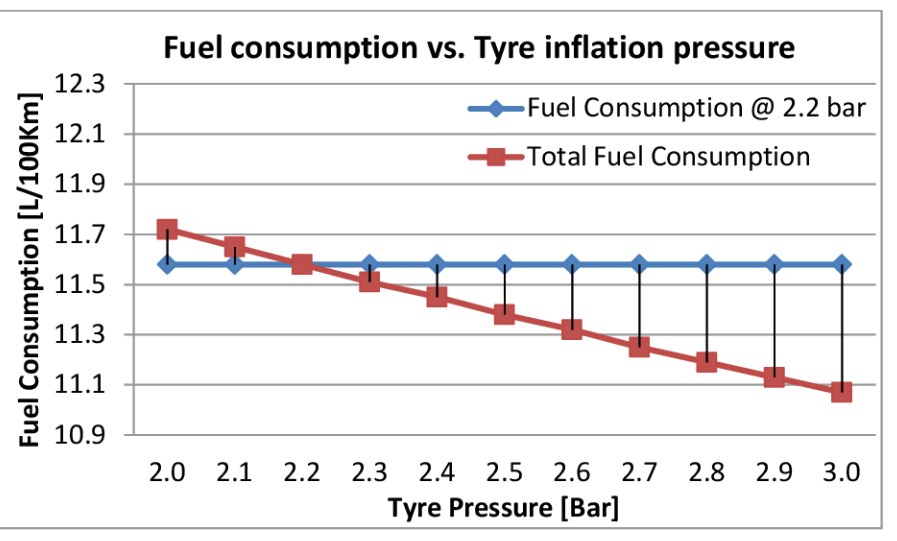
Although overinflating tyres may not be directly related to high fuel consumption, it causes wear over time, which increases rolling resistance. This results in an increase in fuel consumption, causing an increase in fuel economy.
Tyre tread and its impact on fuel economy
Tyre tread and patterns also affect fuel economy, sometimes overlapping with tyre pressure. For example, when overinflated tyres wear, the tyre tread wears down, especially in the centre, and so, once again, rolling resistance increases.
Find out more about tyre tread, patterns and their relationship with fuel economy:
- Greater tyre grip: the greater the tread depth, the more grip the vehicle has, leading to better fuel economy and vice versa. This increase in fuel economy happens because the car will not need as much fuel to move.
- Warped tyres: tread patterns, which help with vehicle traction, significantly influence fuel consumption, negatively or positively, based on the type of vehicle and the context of where and in what conditions the vehicle or fleet is driving. Some of these examples include:
–
Rib patterns: rib patterns are widely recommended because they have lower resistance and run parallel to the tyres on the road.
–
Standard energy tyres: standard energy tyres are not recommended for low fuel economy in private vehicles, as their patterns are not designed to improve fuel efficiency but create more rolling resistance. However, these tyres are still used on most vehicles. According to an article by Tyre World Medium, they are made for the general population to provide durability and comfort.
–
Aggressive tread patterns: using aggressive tread patterns on motorways is not recommended, as they can increase rolling resistance. These tread patterns are built for off-road use.
Cartrack’s innovative solutions will help you prevent and detect a possible increase in fuel economy. Explore more below:
- Automated Preventive Maintenance: With our automated preventive maintenance solution, fleet managers can easily track any maintenance needs and take care of them before they become a bigger, more expensive and more time-consuming problem, with more in-depth repairs and longer downtime. These solutions include real-time alerts so you know precisely when it is time to add more air or replace the tyres, making sure there are no delays in keeping your fuel economy at a healthy level.
- Fuel monitoring: Cartrack’s fuel consumption monitoring can help you track your fleet’s fuel use and spot any spikes in usage. Although this does not necessarily mean the tyres are the problem, it can point to other issues affecting your fuel economy, including your tyres, and so can help you resolve them early.
- Driver behaviour: using our driver behaviour solutions, such as scorecards and driver behaviour reports, fleet managers can monitor whether drivers engage in behaviour that could potentially damage their tyres.
- Driver scorecards: driver scorecards let you watch your drivers for harsh behaviour and reward them with high ratings if they behave well. Some of these harsh behaviours, such as speeding or harsh acceleration, can damage tyres. In other words, encouraging drivers to drive safely, whether through high ratings or by motivating them in other ways, such as bonuses or raises, can help you avoid damage to your fleet’s tyres and a negative impact on your fuel economy.
- Driver behaviour reports: driver behaviour reports provide deep insights into your driver’s habits, such as keeping track of each driver’s aggressive behaviours over time. Once again, this can help you identify behaviour that damages your fleet’s tyres. You can also request instant trip reports to help tackle aggressive behaviour in real time.
- Car tyre deals: if you don’t run a fleet and are looking to improve your fuel economy as a personal-use driver, Cartrack’s experts can negotiate car tyre deals for you, making sure you get excellent tyres for fuel economy.
Answering your questions about fuel economy (FAQs)
Q: How do tyres reduce fuel consumption?
A: As mentioned, tread patterns can reduce fuel consumption depending on several factors, such as tyre pressure, whether the pressure is set correctly and whether the tyre is overinflated or underinflated.
In addition, wheel alignment, size and weight can reduce fuel consumption, among many other factors.
Wheel alignment can reduce or increase fuel consumption depending on whether the wheels are misaligned. Misaligned wheels drag, so they use more fuel, making the engine work harder.
Properly aligned wheels, however, have the opposite effect. There will not be as much drag, the engine will be under less stress and fuel consumption will be lower.
Tyre weight affects rolling resistance, as the lighter the tyre, the lower the rolling resistance, and vice versa, subsequently decreasing and increasing fuel consumption.
Q: What is the best tyre pressure?
A: Tyre pressure is measured in bar or PSI (pounds per square inch). Although every vehicle has its own required tyre pressure, the generally recommended and accepted pressure reading is between 28 and 36 PSI, which converts to approximately 1,9 to 2,5 bar.
Q: How can I choose the right tyres for better fuel economy?
A: Investing in energy-efficient tyres, also known as “eco tyres” or “green tyres”, is a great way to choose the right tyres for better fuel economy. These tyres are low-resistance. Although they can be expensive, the costs you will save in the long run will outweigh the initial outlay.
Q: How can I improve my fuel economy?
A: There are many ways to improve fuel economy; making sure the tyre pressure is at the correct PSI or bar and pumping the tyres up when needed is one way to do it. Another is looking after and choosing the right tyres and making sure the wheel alignment is in order.
Regular maintenance and no speeding, rapid acceleration or deceleration are also recommended. Try to keep a consistent speed or switch to cruise control when appropriate. Remove any extra weight or unnecessary load from your vehicle or fleet.
Take control of your fleet by investing in Cartrack’s fleet management solutions
At Cartrack, our aim is to simplify and automate your fleet management experience with various solutions, such as real-time tracking, improved delivery efficiency and route optimisation.
Contact us today to increase your fleet’s grip on the road and your profits.
 South Africa
 Botswana
 Kenya
 Malawi
 Namibia
 Nigeria
 Swaziland
 Tanzania
 Zimbabwe
 Hong Kong
 Indonesia
 Singapore
 Malaysia
 Philippines
 Thailand
 New Zealand
 Vietnam
 Poland
 Portugal
 Spain
 United Arab Emirates

 PT