Great fleet owners understand that fuel management goes beyond cutting fuel budgets or leaving fuel expenses to employees. Instead, they adopt advanced fuel management to future-proof their business and achieve long-term success.
Controlling your fleet's fuel costs requires fuel monitoring standards, the right fuel monitoring system, data-driven decisions and sustainable practices.
If you think you have done your best at fuel management, here are 10 reasons why you may not have mastered fuel management and efficiency yet.
In this article, you will:
- Learn why companies care about fuel management
- Discover the 10 reasons why companies are failing at fuel management
- Get possible solutions to these fuel management challenges
- Explore Cartrack's Fleet Management System and fuel monitoring solutions
- Get answers to the most frequently asked questions about fuel and fleet management
10 reasons why you are failing at fuel management in your fleet
As your company grows, your fleet's operating expenses, such as fuel, are likely to increase with it, but that does not automatically result in growing profits.
If your fleet is still reporting excessively high fuel costs that choke profits, there may be other factors affecting your fleet's fuel management that you need to pay attention to.
1. Outdated vehicles
It is not so much old cars versus new cars, but ongoing vehicle price inflation has made it harder for ordinary South Africans and companies to buy new vehicles or replace their older, outdated ones. Unfortunately, your outdated vehicles may also be the weak point in your fuel management efforts.
- Lower fuel efficiency: cars become less fuel-efficient as they age, which means you may not get as much mileage from your fill-up and therefore need to refuel more often.
- Greater maintenance needs: wear and tear over the years also increases your vehicle's maintenance needs, sometimes including the frequency of fuel system problems.
Alternative solutions: transition your fleet
Older built-in technology can make it difficult to track fuel use. For example, not all vehicles have CANBus technology, which provides more accurate insights into fuel consumption.
However, the solution to this weakness is not as simple as replacing your fleet with the latest vehicle models. Fuel prices are still a major concern for companies, and fleets that are planning the transition to alternative fuels in the next 12 months need to be more strategic to future-proof their business. Consider joining the growing number of fleets accelerating their transition to EV and slowly replacing outdated vehicles with more economical ones.
2. Lack of driver training on fuel efficiency
Unnecessary speeding, harsh braking and excessive idling are fuel-inefficient practices that you may be overlooking in your fuel management efforts. An untrained driver is less likely to be aware of how these driving behaviours affect fuel efficiency, so while you try to reduce your fleet's fuel costs, these poor driving techniques and habits increase your fleet's fuel use, causing:
- Increased fuel costs: inefficient driving leads to higher fuel consumption per kilometre, directly increasing the fleet's fuel expenses and making fuel costs harder to control.
- Greater risk of fraud and misuse: drivers who are not properly trained, are poorly disciplined or are uninformed about your fleet's standard operating procedures (SOPs) can easily misuse your vehicles, causing an increase in fuel consumption and costs.
Cartrack solution: Fuel efficiency report
Do you know how many litres are consumed per kilometre in your vehicle? (This also changes as your vehicle ages). Abnormal fuel efficiency can indicate fuel theft, high idling or bad driving habits. Do you know how to calculate the efficiency of each of your vehicles?
Our fuel efficiency report was created to help you detect fuel inefficiency in your fleet and introduce measures to reduce your fleet's fuel consumption, especially from untrained fleet drivers, who significantly impact your fleet's fuel management and undo all your efforts to reduce your fleet's fuel consumption and costs.
3. Short trips (stop-start)
Frequent stopping and starting on short trips causes poor fuel economy in your fleet. When you start your vehicle, it generally requires more fuel than when it runs at a constant speed. According to the AA, trips of two kilometres or less use more fuel than longer trips and, depending on the size of your vehicle, short trips can cost you more fuel unnecessarily.
As well as increasing fuel costs and reducing your fleet's fuel efficiency, short trips may be causing your fuel management problems because short trips are:
- Difficult to monitor: Without telematics, fuel monitoring hardware or a fuel management system
- More susceptible to fuel theft and fraud: as it is difficult to monitor or obtain detailed fuel use data for vehicles frequently used for short trips, the risk of fuel fraud and theft increases.
Telematics Cartrack solution: live GPS tracking and fleet visibility
GPS helps make a fuel management system more accurate. By tracking your vehicle’s location and movement activity, you can mitigate the risk of fuel theft on short trips by comparing your fleet’s fuel consumption with the vehicle’s mileage and activity.
Cartrack’s route optimisation generates the best order in which to complete tasks and deliveries, helping you get from point A to B and, finally, to point C more efficiently by generating your route sequence. This software feature is a smarter way to combine several planned short trips into one longer journey and reduce the number of damaging stop-start trips.
With route optimisation, you can order deliveries and service tasks instantly instead of manually planning your route and job order, which is usually less fuel-efficient.
4. Carrying unnecessary weight
There is a relationship between weight and fuel economy, and you will have to pay attention to it when managing your fleet. One extra kg of weight can make the engine work harder and use more fuel when accelerating and braking.
Besides lowering your fleet’s fuel efficiency and increasing your fuel costs, carrying unnecessary weight in your fleet can surprisingly cause:
- Accelerated wear and tear: Excessive or frequent additional weight overloads your vehicle. Over time, this increases wear and tear on your vehicle and the risk of mechanical problems.
- Safety risks: Additional weight makes your vehicle harder for your drivers to handle and compromises the vehicle’s safety.
Cartrack can lighten your load
Although the solution seems simple, the less your vehicle weighs, the less fuel it will use. Drivers can avoid carrying unnecessary items or extra people during trips. But the truth is that it is not only your driver’s additional items (or people) in the truck that may be slowing your vehicle down or causing fuel management problems. Have you assigned the right vehicle to the task?
Paying attention to the capacity of your fleet vehicle helps ensure that your fuel tank is not being drained by unnecessary weight. Cartrack’s Delivery makes sure you assign the right vehicle to your drivers for the job and tasks, automatically notifying you when the job may require a larger capacity.
5. Weather conditions
It may be hard to believe, but weather conditions affect your fleet’s fuel. This is mainly because of how the weather affects your vehicle and driver behaviour. For example, drivers may use the air conditioning often on hot summer days, which reduces fuel economy by 25%! If you think cutting out the air conditioning would work, think again! Driving with the windows open has also been shown to affect the vehicle’s aerodynamic drag and increase the need for more fuel.
Colder temperatures also cause higher fuel consumption and difficult driving conditions that force your vehicle’s engine to work harder. Weather conditions affect your fleet in two ways:
- Hard to mitigate: the weather affects the performance of drivers and vehicles, and fleet managers may find it challenging to mitigate these effects. How weather conditions affect fuel consumption and activity is often overlooked.
- Not just the temperature: wind conditions and rainy weather can also affect your fleet’s fuel efficiency.
Cartrack solution: Be strategic about the weather
The weather is not something you can avoid or dodge, so it is up to you to create fuel management strategies that take weather conditions into account. For example, encourage your drivers not to leave the vehicle idling to warm up and, instead, to drive gently for a few minutes to warm the engine. Alternatively, as mentioned earlier, you can avoid shorter trips on cold days because the vehicle’s engine may take longer to reach the right temperature.
Track vehicle activity and idling through Cartrack FleetWeb. Here, you can customise alerts for idling vehicles or download an idling report for an overview of how often a vehicle idles. By knowing which of your vehicles and drivers are idling, you can quickly address this fuel-inefficient behaviour.
6. Bad driving habits
Some driving habits simply waste your fleet’s fuel, so if you want to save fuel, start by changing and training your drivers to avoid bad driving habits such as speeding, idling and aggressive driving, like harsh braking or acceleration.
Bad driving habits not only reduce your fleet’s fuel efficiency but also put your drivers and vehicles at risk. These common habits cause:
- Higher total consumption: it is estimated that the cost of bad driving behaviour is a 15-30% drop in fuel efficiency on the highway and 10-40% in stop-and-go traffic.
- Higher maintenance and repair costs: reckless driving accelerates wear and tear on your vehicles and can also result in accidents and damage that are expensive to replace or repair.
Cartrack solution: Driver monitoring
You can mitigate bad driving habits by monitoring your drivers, identifying these habits and training them to help them improve. Cartrack’s driver monitoring solutions provide insights into your driver’s performance on every trip, which helps you create driver-specific training and coaching.
With Cartrack’s driver scorecards, you can score how often drivers take high-risk actions such as speeding, harsh braking and sharp cornering, and create custom alerts for bad fuel-wasting habits so that you are notified if your drivers break the rules.
7. Fuel fraud/theft
Fuel fraud and theft have been a fast-growing problem in South Africa, and more companies are investing in identifying fuel fraud. Without the right fuel monitoring tools, your fuel management efforts can be quietly undone by internal fraud involving employees and fleet staff.
There are a few ways fleet staff may be defrauding your fleet, including claiming for fuel that was never put into your vehicles, siphoning fuel from your vehicle’s tank or engaging in other fuel card fraud. What methods are you using to identify fuel theft in your fleet? Even with fuel cards to monitor your fleet staff’s refuelling expenses, there may still be fuel fraud or theft in your company, causing:
- Unnecessary cost to the company: failing to monitor and control fuel expenses results in excessive costs to the company that could be avoided.
- Operational disruption: siphoning and incorrect fuelling can cause costly vehicle downtime and affect your fleet’s productivity.
Cartrack solution: advanced fuel monitoring
Fuel fraud and theft can cost your business a great deal, but without the right fuel monitoring system, it is very easy for you to miss suspicious activity. Cartrack’s FleetWeb with MiFleet makes it easier to monitor fuel theft by sending a notification when there is a spike in fuel consumption and fuel payments that do not line up with your vehicle’s mileage.
8. Misuse of fleet vehicles and machinery
Driver detours, unauthorised activities or the misuse of company vehicles and machinery can significantly impact your fleet’s fuel management in several ways, causing serious financial losses. For example, if one of your employees moves your construction equipment to complete personal projects at a different site but leaves the fuel costs to you, the misuse will be expensive for you.
Alternatively, your drivers and fleet staff can drain your fuel budget by using vehicles for personal purposes, which results in excessive fuel consumption and high costs. These kinds of unnecessary expenses are holding back your progress in fuel management.
Cartrack solution: Geofence and DID
Cartrack Live’s GPS tracking and driver identification tools improve your fleet’s fuel management by ensuring that your company’s vehicles and equipment are not used for personal projects at your expense. Now, you can verify fuel claims, machine and vehicle working hours and other factors by validating where transactions or activities took place and which of your fleet employees were responsible.
9. Poor vehicle/machinery maintenance
Every vehicle and machine requires specific attention to prolong your fleet’s fuel economy and efficiency. Neglecting maintenance and service tasks, such as oil changes, air filter replacements and other engine and tyre checks, lowers your fleet’s fuel efficiency.
When you manage several vehicles and machines of different ages, performance capabilities and locations, it is hard to keep track of and organise maintenance and service tasks for each of your fleets. Neglecting some important maintenance needs in your fleet sets back your fuel management efforts over time, causing:
- Increased fuel consumption: Whether it is engine trouble or problems with the fuel system in general, faulty vehicles in your fleet lead to higher fuel use.
- Lower fuel efficiency: Neglecting maintenance tasks will affect your fleet’s fuel efficiency, making it harder for your vehicles to perform over time.
Cartrack solution: Service reminders and preventative maintenance
Cartrack makes it easy to set up customisable reminders to help you keep track of your vehicle’s maintenance and service needs. This is one of the many useful tools for improving your fleet’s fuel management. Beyond reminders, Cartrack’s FleetWeb platform helps you be proactive about maintenance. Use historical vehicle maintenance and service information in Cartrack’s FleetWeb to predict and plan the maintenance activities your vehicle needs over time.
10. Lack of a modern fleet management system or fuel monitoring system
Your fleet and fuel management systems should be equipped with more modern technologies, such as GPS and telematics for real-time tracking and communication.
Even if you think your fuel management strategy is the best, any lack of real-time tracking capabilities makes it harder for you to identify the problems affecting your fleet’s fuel.
Using the right fuel monitoring tools and hardware for the problem you want to solve is also important. If you have invested in fuel sensors but continue to struggle with your fleet’s fuel consumption or with insights into the fleet’s fuel use, then it is possible that your fleet’s fuel problems are due to something else. Without the right fuel monitoring system, it is hard to:
- Gain visibility of fuel use: Without the right system, managing and controlling the fuel consumption of your entire fleet becomes harder, making it easier for fuel theft or misuse to happen right under your nose.
- Optimise your fleet’s fuel use: Fuel monitoring helps you identify your fleet’s fuel use and provides insights into how to adjust to delivery schedules and minimise fuel inefficiencies.
Cartrack solution: Advanced fuel management
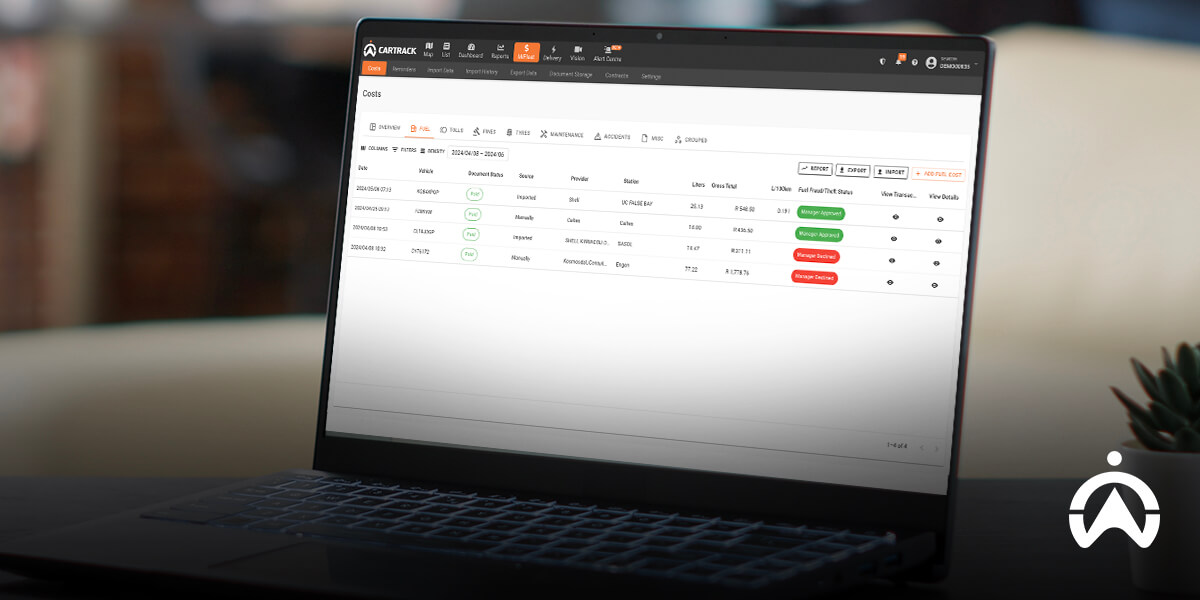
Upgrading your fleet’s fuel management system is the most effective way to monitor your fuel consumption and expenses closely. Our fuel management system helps you identify and address every fleet behaviour that affects your fuel use and provides data-driven insights so that you can make decisions quickly.
Whether you have a small-scale fleet of 5 vehicles or a larger fleet with more than 500 vehicles and specialised machinery, neglecting your business’s fuel management can be costly for your business and its future.
If you have not yet introduced controls for better fuel management, here are five reasons why you should care about your business’s fuel management.
1. High fuel prices and fleet budgets
Fuel prices in South Africa are adjusted frequently and are affected by several factors. Not paying attention to your fleet’s fuel consumption also means inaccurate budgeting. Without a well-structured budget and accurate fuel management, it is hard for you to allocate costs properly and account for other expenses for your vehicles. A fuel tracking system is one of the most effective ways to track and manage your fuel costs.
2. Manual fuel cost accounting
When you are analysing and managing diverse vehicle fleets, including low-powered engine machinery, that may be located across the country and even beyond the border, using manual methods for fuel cost accounting is impractical. Besides, there are many automation tools, such as fuel cards and fuel monitoring systems, that provide more accurate fuel cost accounting.
3. Missing fuel fraud, theft and other risks
Without proper fuel management, you may be missing or overlooking fraudulent fuel activities that drain your fleet. Fraud risks such as fuel theft, misuse and fuel card fraud can be avoided with the right fuel monitoring measures.
4. Lack of visibility of vehicle use
Because of a lack of fleet visibility, vehicle misuse and abuse by drivers and other employees can easily go unnoticed. Fuel management helps detect this misuse and ensures that the costs of this kind of activity do not fall on you.
5. Environmental impact of running your fleet
Customers increasingly prefer more sustainable initiatives from companies. Sustainable fleet transformation usually requires companies to buy new low-emission vehicles or electric vehicles, but getting ahead with your fuel management is one of the most effective ways to improve your fleet’s environmental impact.
Cartrack’s fleet management system is equipped with everything you need for effective fuel management and the success of your fleet. You have the complete guide to fleet management systems. Are you ready to start using Cartrack?
Get in touch with us for a demo.
Useful frequently asked questions about fuel management
- What are the difficulties in fleet management?
Fuel management is often cited as one of the toughest challenges for fleets. This is because fuel prices fluctuate constantly and, with every fuel price increase, bad driving habit and other fleet inefficiency, there is a direct cost to the company.
- What is the biggest problem a fleet company faces?
Managing high costs is a major challenge for fleet management because it affects your company’s ability to compete in the market. For example, if your delivery company is forced to raise the cost of its service to customers, this may push them to find a cheaper delivery company.
- How can I improve my fleet management?
An advanced fleet management system with other integrated technologies, such as GPS tracking, cost management software, fuel management software, fleet reporting tools and task and delivery management tools, can help you improve your fleet management.
- How do you manage fuel for the fleet?
This quick step-by-step guide is a starting point for fuel management, but here is a more detailed guide:
Step 1: gain complete fleet visibility with GPS tracking.
Step 2: Use fuel monitoring systems to monitor and analyse fuel use.
Step 3: Use route planning and optimisation.
Step 4: Use fleet cards to manage refuelling.
Step 5: Maintain your fleet regularly.
Get a quick demo of our fuel management system here.
 South Africa
 Botswana
 Kenya
 Malawi
 Namibia
 Nigeria
 Swaziland
 Tanzania
 Zimbabwe
 Hong Kong
 Indonesia
 Singapore
 Malaysia
 Philippines
 Thailand
 New Zealand
 Vietnam
 Poland
 Portugal
 Spain
 United Arab Emirates

 PT