Knowing how your fleet’s vehicles and equipment work is crucial to developing an effective, well-oiled fleet management system.
As an indispensable component for fleet vehicles with unique or specific purposes, power take-off is important to understand if you want to get the most out of your fleet’s daily activities.
Read on to learn all about power take-off, how it works and how to use power take-off monitoring to transform your fleet’s operations.
In this article, you will:
- Get to know the fundamentals of power take-off and how it works
- Identify the types of vehicles and equipment that use PTO
- Familiarise yourself with the different types of PTO
- Get detailed information on PTO monitoring and sensors
- Discover how PTO monitoring can transform fleet management
- Learn more about advanced power take-off monitoring solutions from Cartrack Mozambique
The basic principles of power take-off (PTO)
Power take-off, or PTO, is a fundamental part of the operation of many fleet vehicles, especially those with additional functions such as raising truck beds, cranes or any other function needed without directly using the power of the vehicle’s engine.
What is the principle of power take-off?
Think of power take-off as a portable power generator that transfers power from your vehicle’s engine to an auxiliary component such as a crane or hydraulic pump. Ultimately, it helps transfer power to other essential parts of a vehicle without using the main power source. This brings many benefits, such as ensuring an even, consistent power distribution that meets the vehicle’s specific requirements.
Which vehicles and equipment have power take-off?
With the potential to power a wide range of equipment, PTO is commonly used in fleet, construction and other industrial vehicles with the following types of equipment:
- Auxiliary equipment
These devices use the engine’s power to perform specific functions, such as pulling heavy loads or operating hydraulic systems on commercial trucks or other industrial vehicles.
- Attachments for Commercial Vehicles
Accessories such as tow arms and compressors use the power take-off powered by the vehicle’s engine to work optimally.
- Construction equipment
Any auxiliary attachments, such as concrete mixers, cranes or concrete pumps, work efficiently using the power of the vehicle’s engine, thanks to power take-off.
Types of power take-off and how they are applied
Seeing how many different types of equipment PTOs can power, it’s also important to establish whether there is more than one type of power take-off and identify their advantages and disadvantages.
- Looking more closely at how PTO is applied, there can be a slight difference in application. For example, one mechanical type, known as a power take-off, is connected to the engine by a belt or shaft. However, while its constant power supply makes it an excellent tool, it can be subject to costly repairs, as it is prone to wear and tear over time.
- Another type of mechanical power take-off is called an auxiliary or independent power take-off. Here, the speed of the power take-off is completely independent of the vehicle’s speed and it can be switched on or off while the vehicle is moving.
- Hydraulic power take-off is the third type. It uses hydraulic fluid to transmit power from the engine to the external component with the power required. Hydraulic PTO is a great option thanks to its greater efficiency, but it is also more expensive than live power and independent PTO.
Overall, hydraulic power take-offs are more popular thanks to their greater efficiency.
How does power take-off monitoring work? Unpacking everything you need to know
Not only is power take-off a valuable device that provides additional power for a variety of fleet, construction and agricultural vehicles, but keeping an eye on your fleet’s power take-off also brings some fantastic benefits for improving its performance.
Power take-off is monitored by means of a specialised sensor. By being able to follow power take-off activity, you can keep track of the productivity of your fleet’s vehicles. Let’s take a closer look at how this sensor works and how it measures power take-off activity.
How the power take-off sensor works its magic
The PTO sensor is a small device designed to detect and monitor any auxiliary or support activities driven by the vehicle’s engine, making this sensor a game changer for checking vehicle use in terms of working hours and productivity.
The main mechanism of the power take-off sensor is triggered when a vehicle’s on/off indicator is activated, which creates an event that can be recorded in a linked telematics system. PTO sensors can pick up a variety of support activities, making them very versatile in a fleet setting across various working environments.
A power take-off gets its power from the vehicle’s engine and needs to be engaged before it can start transferring power. As there is more than one type of PTO, there is more than one method of engagement; so, for example, it can be through air pressure or hydraulic pressure. Once the power take-off is engaged, its output shaft will transfer the power to the auxiliary element, driving the function or component linked to the vehicle. A good example here would be moving the mechanical arm of a construction vehicle.
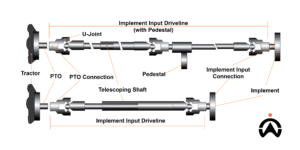
Common types of PTO monitoring data
Power take-off sensors detect specific activities depending on the type and function of the vehicle. For example, a crane’s power take-off sensor will pick up the movement of the crane’s arm, while a tipper truck’s power take-off sensor will detect the raising of the truck’s bed.
Take a look at some of the most common types of data collected by a PTO sensor.
- Trip fuel used
- Oil temperature
- The power take-off is engaged, meaning the vehicle is working as it should
- PTO idling (productive idling vs. unproductive idling)
All of these are examples of crucial information fleet managers need to determine their fleet’s productivity levels and whether it is over- or underperforming.
The link between power take-off monitoring and effective fleet management
Power take-off allows ordinary vehicles to do extraordinary things across every industry, simplifying construction, agriculture, waste disposal and much more. Power take-off monitoring also brings great benefits for fleet managers and can transform your fleet’s daily performance, supporting increased productivity during set working hours. Here are some of the main reasons why you should consider power take-off sensors for your fleet.
Why you need PTO sensors for your business
There are several ways to monitor your fleet’s activities with telematics, but external PTO monitoring adds relevant information with a great deal of potential value for fleet management. Consider the following advantages of having power take-off sensors in all your fleet vehicles and how this extra tool can improve your fleet’s overall performance.
- Better cost management and fuel use: An active power take-off means a vehicle is busy carrying out additional activities, resulting in increased fuel use. Tracking power take-off engagement patterns can help develop crucial fuel and cost-saving strategies.
- Greater safety and compliance: some industries require reporting or tracking to ensure regulatory standards are met, and power take-off monitoring can add value here by offering valuable data. From unauthorised use to the misuse of fleet vehicles and equipment, PTO sensors help promote safety and compliance in the workplace.
- Accurate diagnostics and troubleshooting: hit the nail on the head when troubleshooting with useful data, such as irregularities. Knowing about inconsistencies helps you track down and resolve the root cause or problem, rather than just the symptoms.
- Optimised maintenance planning: Fleet vehicles have extended active hours, leading to inevitable wear and tear and a greater need for servicing and maintenance. PTO data can help provide context on running time and engagement frequency, helping to estimate smart preventive service and maintenance times.
- Operational competence: PTO monitoring can provide crucial information not only on when, but also on how fleet vehicles’ PTOs are used. Fleet managers can use this information to improve overall operational proficiency and prevent unauthorised use of company vehicles, which can have a positive effect on company budgets and annual ROI.
How Cartrack Mozambique’s specialised sensors helped Concord Cranes step up its fleet monitoring
Concord Cranes provides crane hire solutions in South Africa. With more than 180 cranes, its services range from transport to specialised lifting projects and mobile crane hire; however, they struggled to accurately record their equipment’s working hours, impacting on-time deliveries and overall customer satisfaction.
This is just one of many examples of how advanced SaaS products from Cartrack Mozambique can help you gain full control of your fleet.
Cartrack Mozambique’s advanced sensors can help optimise your fleet’s productivity
As well as power take-off being a crucial component in the operation of many construction, agricultural and other commercial vehicles, its monitoring potential can transform the way you manage your fleet. Understanding the power of monitoring your PTO is key to having full control and keeping your fleet’s performance on track.
Sign up with Cartrack Mozambique today and get the tools to help boost workplace productivity and advance your fleet’s operations.
 South Africa
 Botswana
 Kenya
 Malawi
 Namibia
 Nigeria
 Swaziland
 Tanzania
 Zimbabwe
 Hong Kong
 Indonesia
 Singapore
 Malaysia
 Philippines
 Thailand
 New Zealand
 Vietnam
 Poland
 Portugal
 Spain
 United Arab Emirates

 PT