Aggressive driving behaviour is one of the biggest challenges fleets face, but do you know how it is measured?
The short answer? G-force. No, we are not talking about the film with cute guinea pigs who work as secret agents; we are talking about gravitational force. But how exactly does it work, and why does your fleet need to be aware of it? Let's find out.
In this article, you will:
- Learn exactly what G-force is
- Discover the crucial role G-force plays in measuring harsh driving behaviour
- Find out what damage aggressive driving can do to your fleet
- Understand the importance of a driver monitoring system
- Get unrivalled safety for your whole fleet with our driver monitoring system
What is g-force?
A g-force, often called gravitational force, is defined as a measure of acceleration. In simpler terms, it is how much you are pushed or pulled when accelerating, braking or turning. When we are standing on the ground, the weight and force that stop us from floating are equal to one “g”. This measure serves as a metric for quantifying any form of acceleration, making it important in several fields, including aviation, the military and the fleet industry.
What is harsh driving?
Harsh driving can be defined as any sudden change in the direction or speed of a vehicle or truck travelling at a steady pace. It is often noticed as sudden changes in G-forces that can be monitored by an accelerometer, a device that measures changes in the speed or direction of a moving body (in this case, a vehicle).
When an accelerometer is at rest, it measures one g-force, which is the force of gravity acting on it. When the accelerometer is moving, it measures the difference between the force of gravity and the force of acceleration acting on it. The accelerometer measures acceleration in metres per second squared (m/s²), and this can be converted into g-force by dividing the acceleration by the acceleration of gravity (approximately 9,81 m/s²).
Accelerometers are widely used in transport, including in airbags, where they detect sudden changes in a car's speed, signalling an imminent collision, and trigger an electrical circuit that makes the airbags inflate.
Harsh driver behaviour is usually expressed in terms of G-force because of its role in monitoring behaviour. This is done by measuring the magnitude of the acceleration and deceleration a vehicle experiences. Because harsh driving subjects the vehicle to abrupt changes in speed, direction or both, a sudden increase in the G-force experienced by the driver, the passengers and the vehicle itself is a key indicator of harsh driving.
Harsh driving is expressed in terms of G-force because it plays a crucial role in measuring the magnitude of the acceleration or deceleration a vehicle experiences.
Aggressive driving is a broad term used to describe a range of behaviours behind the wheel. Here are the four most common forms of harsh driving:
- Harsh braking: Harsh braking happens when the driver uses more force than necessary to stop a vehicle. Although there are some understandable cases where harsh braking cannot be avoided (such as stopping to avoid an accident), unnecessary harsh braking can suggest distracted driving, as it is a common effect when drivers fail to keep a safe following distance. This increases the chances of a rear-end collision, as there is not enough following distance to allow a sudden but safe deceleration.
- Harsh acceleration: Harsh acceleration happens when drivers use more power than necessary to move the vehicle after stopping. Often seen when drivers are waiting at a traffic light and step on the accelerator to move off as fast as possible, when drivers accelerate quickly in an attempt to beat a red light or when drivers are not paying attention to the flow of traffic and need to accelerate from a stop line, harsh acceleration can be a sign of distracted driving. It often suggests a lack of focus, impatience or an attempt to make up for lost time without paying attention to traffic signals or the surroundings.
- Sharp cornering: Also known as sharp cornering, harsh cornering is defined as a driver accelerating into a bend, which makes them take the corner too fast. This is quite dangerous, as it puts more force on the vehicle's tyres. It means the driver can lose control of the vehicle completely, causing accidents with other vehicles. It also puts heavier vehicles at risk of rolling over. And it leads to limited visibility of the road beyond the bend, which puts drivers at risk of meeting obstacles.
- Lane departure: Lane departure is defined as a driver unintentionally leaving their lane and crossing into another lane or onto the hard shoulder. When a driver takes their attention off the road, even for a moment, the likelihood of drifting out of the lane rises sharply. This is dangerous, as it increases the likelihood of collisions with adjacent vehicles and poses a risk to oncoming traffic. It can indicate distracted driving, as taking your eyes off the road can cause you to drift. It can also indicate a lack of adequate following distance, increasing the risk of rear-end collisions.

How does aggressive driving affect fleets?
Aggressive driving can have significant negative impacts on fleet vehicles, affecting not only safety but also the fleet's overall efficiency. Here is how:
- Shortens the life of fleet vehicles:
Aggressive driving significantly affects the longevity of fleet vehicles in the following ways:
– Increases tyre wear: Harsh acceleration forces the tyres to grip the road intensely, leading to more friction and heat generation. This excessive stress leads to premature tyre wear, which shortens the life of the tread and compromises the tyre's structural integrity. Harsh braking can also cause uneven wear patterns on the tyres, shortening their life and requiring more frequent replacements.
– Increases strain on the brake system: Frequent harsh braking leads to increased wear of the brake pads, and this intense friction results in a shorter brake pad life, which compromises the vehicle's safety.
– Increases strain on the suspension system: Harsh driving puts pressure on the vehicle's suspension parts, such as shock absorbers, struts and bushings, which reduces their effectiveness. These components are important for maintaining the vehicle's stability and the proper working of the steering system, which makes your vehicles more susceptible to mechanical failures.
- Increases your fleet's fuel consumption:
Aggressive driving has been shown to increase the amount of fuel your vehicle burns in the following ways:
–
Increases fuel consumption through downshifting: Harsh braking has been shown to increase your vehicle's fuel consumption dramatically, thereby reducing its fuel economy. When a driver brakes harshly, the vehicle's transmission shifts down to the lowest gear. Although this downshift is necessary to compensate for the sudden drop in speed, lower gears require more engine revolutions to keep moving, which means more fuel is burned. Tests have indicated that aggressive driving can increase fuel consumption by approximately 40%.
– Reduces fuel economy: The increased fuel consumption that results from harsh driving negatively affects your fleet's fuel economy. A study by the Oak Ridge National Laboratory indicated that aggressive driving can reduce fuel economy by 15% to 30%.
- Reduces tyre performance:
Harsh driving can have the following negative impact on the performance of your vehicle's tyres:
– Causing uneven wear: Harsh driving contributes to uneven tyre wear. Harsh acceleration makes the tyres fight against intense friction, wearing the tread unevenly. Harsh braking also forces the tyres to work against the road surface, resulting in uneven wear patterns that shorten the tyre's life.
– Causing flat spots: Harsh braking can cause flat spots, which occur when the tyres skid or lock up, making them slide across the road surface. This wears specific parts of the tyre tread faster than others, creating uneven wear patterns and reducing the tyre's effectiveness and life.
– Increased heat build-up: Harsh driving generates excessive friction, which leads to greater heat build-up in the tyres. Overheated tyres speed up the deterioration of the tyres' rubber compounds and make them more susceptible to blowouts and structural damage.
- Increases the risk of collisions:
Harsh driving increases the risk of vehicle collisions in the following ways:
– Increased risk of rear-end collision: Aggressive driving reduces the safe distance between vehicles, lowering the driver's ability to respond to sudden changes in the flow of traffic and increasing the risk of collisions
– Reducing response times to potential hazards: Aggressive driving compromises the driver's ability to respond promptly to unforeseen situations, such as a vehicle suddenly changing lanes, pedestrians crossing unexpectedly or obstacles on the road. This reduction in response times increases the likelihood of accidents, as the driver does not have enough time to avoid potential hazards on the road.
– Compromising vehicle stability and control: Harsh driving destabilises the vehicle, which affects its handling. This makes it harder to manoeuvre safely, especially in emergencies where drivers need to adjust their driving quickly and take sudden action. This compromised control significantly increases the risk of accidents.
- Increases fleet maintenance costs:
Aggressive driving increases your fleet's maintenance costs by:
– Increasing wear and tear on vehicle components: Harsh driving behaviour puts pressure on critical vehicle parts such as brakes, tyres, suspension systems, transmission and engine components. This subjects these components to premature strain, causing them to wear out sooner than planned. It means fleet managers need to allocate more time and resources to frequent maintenance, part replacements and repairs, which leads to unplanned vehicle downtime and higher maintenance costs.
- Harms driver performance:
Aggressive driving affects your driver's performance in the following ways:
– Reduces response time: Harsh driving behaviour lowers the driver's ability to react quickly to unexpected situations, leading to delayed reactions that increase the likelihood of accidents.
– Increases stress levels: Aggressive driving has been shown to induce physiological stress responses, which increase the driver's anxiety and tension. This added stress not only affects the driver's mental well-being, but also impairs their cognitive function, which affects decision-making abilities and reaction times.
– Increases fatigue: The physical effort caused by harsh driving, such as harsh acceleration, braking and steering, can increase driver fatigue. Over time, this constant effort contributes to greater exhaustion and reduced focus, especially on long-distance trips. This lowers the driver's situational awareness and impairs their judgement, increasing the potential for accidents.
To spot harsh driving, you need to keep an eye on your fleet's driver behaviour. Although this may seem like a challenge, a driver monitoring system is the key to simplifying the whole process.
What is a driver monitoring system?
A driver monitoring system is an advanced vehicle safety technology that combines hardware and software to consistently monitor and assess the driver's behaviour, attention and general condition while they are behind the wheel. This cutting-edge technology combines sensors, cameras and advanced data processing mechanisms that work to give you convenient, unrivalled access to the behaviour of your fleet's drivers. The main aims of this safety-focused system are to increase safety, prevent accidents caused by driver distraction or fatigue, improve overall driver performance and increase the fleet's overall efficiency.
How does driver monitoring work?
Driver monitoring systems are very complex, using a wide range of components that work together to monitor driver behaviour effectively. These components include:
- Cameras: Cameras are the foundation of driver monitoring systems. By using driver-facing cameras equipped with infrared light-emitting diodes, the systems can track the driver's head position, eye movements and facial expressions. These cameras are also equipped with advanced AI algorithms that work to continuously analyse driver behaviour and detect signs of distraction, drowsiness or impairment.
- GPS tracking: GPS tracking is another crucial component of driver monitoring systems. By using GPS tracking, fleet managers gain access to data on driver routes, stop locations and the real-time location of their vehicles. This comprehensive view of a vehicle's movements provides valuable information about driver behaviour, such as speeding, idling or unauthorised detours.
- Driver scorecards: Driver scorecards are comprehensive performance assessment tools that can evaluate the behaviour of a
driver within a fleet. They give fleet managers detailed information about individual driver behaviour, covering factors such as speed compliance, harsh braking and adherence to assigned routes.
- Data processing and analysis: Data processing and analysis are essential for effective driver behaviour monitoring. By collecting and presenting a wide range of data on driving patterns, vehicle movements and location, this system helps fleet managers detect patterns and easily identify cases of aggressive driving.
What are the benefits of a driver monitoring system?
Although the main reason for implementing a driver monitoring system may be to eliminate harsh driving, this system produces a wide range of benefits that have a positive impact on your whole fleet operation. These benefits include:
- Improving the safety of fleet drivers: Driver monitoring systems provide a combination of hardware and software that monitors driver behaviour 24 hours a day. This advanced software works to detect signs of distraction, drowsiness and fatigue, which makes it key to preventing accidents, as these behaviours can significantly increase the risk of accidents.
- Reducing the risk of accidents: A driver monitoring system helps prevent potential accidents by identifying distracted or tired behaviour behind the wheel and alerting drivers to it. These behaviours significantly increase the risk of collisions and loss of vehicle control. When these signs are detected, the system can issue alerts to the driver, prompting them to refocus their attention.
- Reducing fleet maintenance costs: By promoting smoother, safer driving habits, driver monitoring systems help reduce wear and tear on vehicle components. Extending the life of brake components, suspension systems and tyres translates directly into lower maintenance and repair costs.
- Improving the fleet's fuel efficiency: Driver monitoring systems work to detect various driving behaviours that waste fuel, such as excessive idling, harsh acceleration and speeding, and alert drivers to them. This helps drivers correct their behaviour quickly, playing a significant role in improving your fleet's fuel efficiency. This contributes to cost savings by reducing fuel consumption across your whole fleet.
- Improving overall fleet efficiency: Driver monitoring systems significantly reduce accidents, which means less downtime. Less downtime due to accidents or breakdowns allows uninterrupted fleet operations, which ensures tasks, deliveries or services are completed on time. This leads to greater customer satisfaction and loyalty, improving the fleet's overall efficiency.
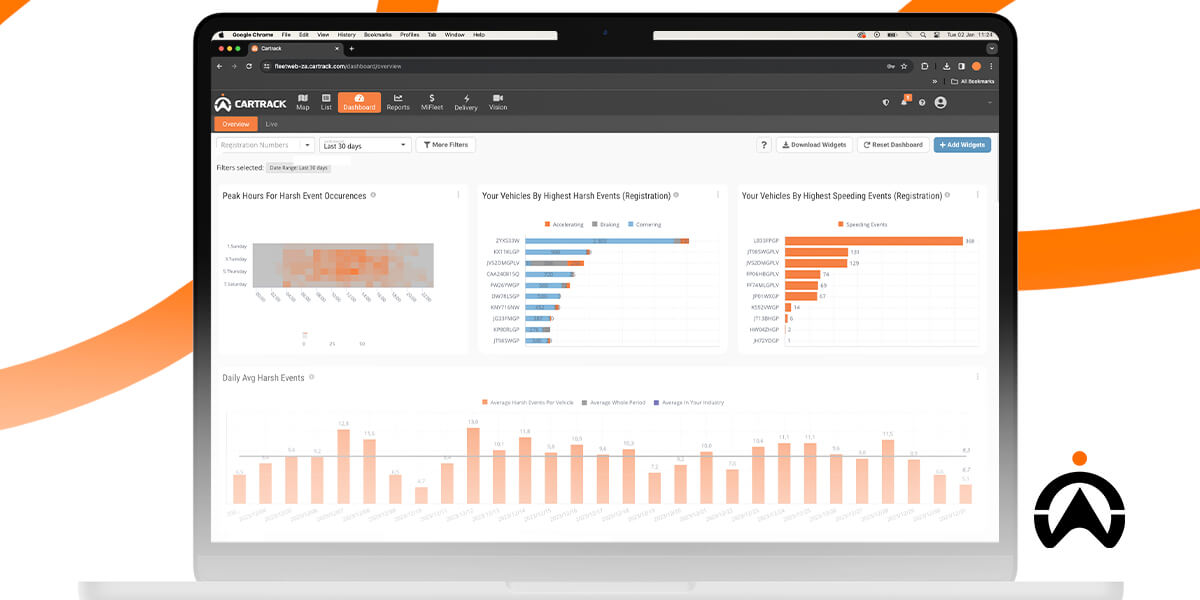
Get unrivalled insight into driver behaviour with Cartrack Mozambique's driver monitoring system
Cartrack Mozambique is here to bring a world-class driver behaviour monitoring system straight to your fleet. Equipped with a wide range of technologies that help you take your driver behaviour to the next level, our system is exactly what you need to improve your fleet's driver behaviour and reap the benefits of a safely run fleet. These include:
- ADAS
Keep your drivers aware of their surroundings with Cartrack Mozambique's Advanced Driver Assistance System (ADAS). This is a technology designed to increase fleet safety and efficiency. By alerting your drivers to potential hazards on the road, detecting and responding to obstacles and helping them keep a safe distance from other vehicles, ADAS works to increase your drivers' awareness of their surroundings.
These features are made possible by the integration of camera-based sensors, artificial intelligence and smart algorithms, which work together to provide driver-assistance features that improve the safety of the driver. These include:
– Data processing
– Driver-assistance features, including:
Automatic emergency braking: This feature quickly identifies potential collisions and automatically applies the vehicle's brakes. This helps minimise the impact or avoid the collision altogether.
Forward collision warning: This feature quickly alerts your drivers when the vehicle is approaching an obstacle or vehicle too quickly, which can help them avoid rear-end collisions.
Blind spot detection: this feature quickly alerts your drivers to vehicles that are in blind spots, helping them reduce the risk of accidents when changing lanes.
- Live Vision AI cameras
Get 24-hour visual access to your fleets with Cartrack Mozambique's Live Vision AI cameras, an AI-powered live-streaming technology. This cloud-connected video management solution uses AI analytics to provide access to driver behaviour monitoring and real-time alerts. This technology can also detect various forms of distracted or dangerous driving, including:
– Speeding
– Smoking
– Fatigue
– Mobile phone use
When any of the behaviours above is detected, audible in-cab alerts are triggered, immediately notifying your drivers. This helps them correct their actions in real time, preventing possible accidents. In addition, fleet managers can also receive these alerts in real time and access the footage through a live stream, which helps them ensure preventive action is taken immediately.
- Driver scorecards
Get an overview of each of your drivers and their behaviour with Cartrack Mozambique's driver scorecards, helping you determine how safely they drive. This is done by tracking any high-risk behaviours, such as
– Harsh acceleration
– Harsh braking
– Excessive idling
– Speeding
These scorecards help identify the specific areas in which drivers need training. They help you give them targeted training to improve their behaviour behind the wheel. This is a crucial part of an effective driver monitoring system, as it helps identify specific indicators of harsh driving, along with the drivers who display these behaviours.
- Fuel monitoring
Keep track of your vehicle's fuel levels and quickly identify harsh driving with Cartrack Mozambique's fuel monitoring system. Our real-time fuel level monitoring uses advanced sensors installed inside the fuel tanks, which allow live monitoring of fuel consumption through our fleet management platform. By helping you conveniently monitor fuel levels as changes happen, it lets you quickly identify sudden spikes in fuel consumption, which can be a sign of harsh driving, with behaviours such as excessive idling, speeding and harsh braking contributing to higher fuel consumption.
- Crash detection.
Ensure your drivers receive immediate assistance in the event of a collision or car accident with Cartrack Mozambique's crash detection. However much your drivers may apply safe driving strategies, that does not guarantee other drivers will show the same vigilance and safe driving habits on the road. By using our smart device, which detects a crash or accident through special G-force sensors and AI algorithms, we can detect and pinpoint the exact location of accidents in real time. This allows us to contact you quickly and send emergency services to your driver's live location if they are involved in a car crash or accident.
Let Cartrack Mozambique help you streamline
Are you ready to establish a driving culture that prioritises safety in your fleet? Start the journey to better driver safety with Cartrack and gain access to world-class technologies.
Contact us today and embrace greater driver safety for your fleet.
 South Africa
 Botswana
 Kenya
 Malawi
 Namibia
 Nigeria
 Swaziland
 Tanzania
 Zimbabwe
 Hong Kong
 Indonesia
 Singapore
 Malaysia
 Philippines
 Thailand
 New Zealand
 Vietnam
 Poland
 Portugal
 Spain
 United Arab Emirates

 PT