When it comes to managing fuel efficiently and reducing costs for your fleet business, fuel credit cards stand out as one of the leading solutions.
Explore the ins and outs of these cards and discover how they can ease all your headaches over fuel expense control.
Is it time to invest in some fuel cards? All your answers are here.
In this article, you will:
- Discover the key insights into fleet fuel card integration
- Understand the steps to integrate fuel cards into your fleet
- Learn how to tackle fuel cost management challenges with fuel cards
- Explore the advantages of using fuel cards in your business
- Discover how Cartrack’s MiFleet system improves fuel card monitoring
Fleet fuel cards — your answer to efficient fuel cost management
These nifty cards are used by drivers to refuel company vehicles quickly, sparing fleet managers headaches and confusion. Fuel cards help managers keep track of all their fuel expenses with ease. You will know instantly which driver filled up, which vehicle they used, how much they spent and where they filled up.
Say goodbye to endless fuel-related paperwork. Now drivers can enjoy the convenience and safety of fuel cards and not worry about handling cash and receipts.
How to get started: Fleet fuel card integration
Empower your fleet with fuel cards, the game changer for managing your fuel expenses. Equipping your business with this feature brings a list of benefits, but before we dive into them, here is a quick step-by-step guide on how to get a fuel card:
- Explore fuel card providers:
Look into reputable fuel card providers in your area, such as oil brands like Shell and BP, or specialist fuel card companies. Take into account factors such as coverage, acceptance at various fuel stations, fees and additional features.
- Compare the offers:
Assess the offers from different fuel card providers. Examine features such as spending controls, reporting capabilities and any extra services they may offer.
- Select a provider:
Choose the fuel card provider that best suits your business needs and offers the most suitable features for effective fleet management.
- Complete the application:
Most fuel card providers make it easy to apply online. Fill in the required information, which typically includes details about your business and fleet.
- Receive approval:
Once your application has been approved and you have received the cards, it is time to activate them by following the provider’s instructions.
- Assign cards:
There are two methods of assigning fleet cards: assigning them to individual drivers or to each vehicle.
– Vehicle – If your drivers regularly use different vehicles, assign a card to each vehicle, instructing drivers to leave the card in the vehicle for the next driver to use when needed.
– Driver – If they mostly stick to one vehicle, give each driver a unique PIN that works with all the cards. That way, you can track which driver refuelled which vehicle.
- Implement restrictions:
Fuel cards give drivers easy refuelling, but it is not without limits. Managers can control fuel card use by setting some of these limits:- Litre or cash limit per transactionLitre or cash limit per transactionLitre or cash limit per transaction
– Number of transactions made per day for each card
– Time of day limit
– Fuel type
This prevents overspending, empowering managers to decide the fuel spend of each driver or vehicle.
Now that you have your provider and your cards, it is time to integrate them into your fleet; this is done by linking the cards to your fleet management system.
Here are three approaches to making that happen:
- . API integration:
Several systems for fleet management come with Application Programming Interfaces (APIs) that allow seamless communication and data exchange with various systems; in this case, that would be between your fleet management system and the fuel card provider.With API integration, you can automatically bring fuel card data into your fleet management system so that, whenever a fuel transaction takes place, the data flows seamlessly from the fuel card provider’s system to your FMS, providing real-time updates on all fuel purchases.
- Data integration platform:
If your fleet management system or fuel card provider does not offer direct API integration, you can opt for a data integration platform. These platforms act as intermediaries, translating data between two systems. It will regularly check for new fuel transactions from the fuel card provider, translate the data into a format compatible with your FMS and import it into your fleet’s system, ensuring smooth communication.
They offer similar benefits to APIs, such as automated data import and detailed reports, but may involve a subscription fee and a complex set-up.
- Manual data import:
Although not ideal, some businesses may resort to importing fuel card data manually through spreadsheets or CSV files.Although this method is time-consuming and prone to errors, it can serve as a temporary solution for those who are not ready for advanced integration solutions like those listed above.
Why use fuel cards?
Fuel cards offer a range of advantages for businesses. Imagine your drivers enjoying hassle-free refuelling at almost every petrol station in the country. Not only that, but many fuel cards also bring extra savings at the pump through fuel discounts and VAT savings, putting more money back in your pocket.
Think of the convenience of having an organised system that monitors fuel spending. Your fuel cost records will always be up to date, making control easier and minimising financial losses. When it comes to safety, fuel cards act as a shield against unauthorised purchases, safeguarding your budget and your drivers, because with no cash in hand the risk of them being robbed goes down.
Why should you integrate fuel cards into your fleet business?
Similar to credit or debit cards, fuel cards are designed exclusively for fuel-related transactions. Here is a breakdown of their advantages:
- Fuel purchasing: drivers use these cards to buy fuel at specific stations, linking the spend directly to the business.
- Expense tracking: Every time the card is used, it keeps a record, giving a detailed view of each vehicle's fuel costs.
- Cost control: Fleet managers can set spending limits on these cards, ensuring fuel purchases stay within budget.
- Data integration: These cards can communicate with fleet management software, giving a clear picture of fuel usage, efficiency and costs.
- Security: Fuel cards come with features for safety, such as PIN codes, ensuring that only authorised drivers can use them and, as drivers no longer carry cash, they are no longer at risk of being robbed on the job.
- Convenient reporting: Fleet managers can easily generate reports showing all fuel-related expenses, making money management easier and more accurate.
- Acceptance network: These cards work with specific fuel networks or stations, so it is essential to choose the one best suited to your fleet's convenience.
Reduced admin work: No more hassle with manually keeping records of fuel receipts and reimbursements. These cards save time for both drivers and fleet managers.
Common methods of fuel theft carried out with fuel cards
Fuel theft can have a significant impact on businesses, affecting several aspects of operations. There are countless ways criminals can steal fuel from fleet vehicles. One of the most popular fuel theft trends is siphoning (sucking fuel out of a vehicle into a container for personal use), but when it comes to your fuel card, the following methods are more commonly used:
- False transactions: this type of fuel theft happens when petrol station staff conspire with thieves. The attendant swipes the fuel card several times for a single transaction, resulting in multiple charges on the cardholder's account. This method is hard to detect because the transactions come from a valid fuel card and the fuel sensors pick up no unusual activity, as the tank was empty and needed refilling, justifying the purchase.
- Fuel card fraud: Fuel card fraud happens when unauthorised individuals obtain and use a company's fuel card to buy fuel for their own vehicles. This can be done by stealing a physical card, skimming card data at fuel stations or using stolen card information to create fraudulent transactions online. These cloned cards can then be used to buy fuel at any petrol station.
Easily manage your fuel cards and overall fuel costs with Cartrack Mozambique
Unlock a range of benefits and gain full control over your fleet's fuel expenses with Cartrack Mozambique. We provide reliable fleet management solutions that can help you manage your fuel costs and improve operational efficiency.
Here are some of the ways Cartrack's fleet management software and MiFleet can help you in your quest to take control of your fleet's fuel costs:
Easily monitor and manage your fuel card with Cartrack Mozambique's MiFleet system
MiFleet is a cost management system that monitors all your fleet's administration and running costs, including toll fees, maintenance costs and all fuel spending.
When it comes to fuel card monitoring, MiFleet can analyse fuel card transactions and automatically cross-check them against your vehicle's telemetry data to quickly identify which driver stopped to refuel, for which vehicle, and at what time and place.
Simply by importing your fuel card transactions into the MiFleet system, our MiFleet AI system automatically tracks all fuel card usage and presents the information in an easy-to-understand format on the MiFleet digital platform, making your fuel data easier to manage.
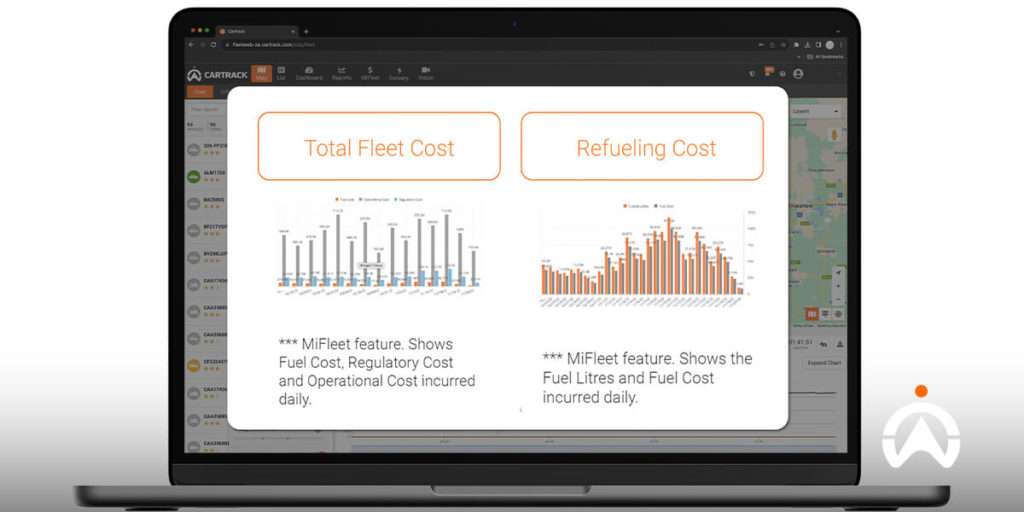
with MiFleet you can:
Monitor fuel consumption:
Get insight into fuel consumption rates per km, current fuel levels and fuel-wasting events such as abnormal idling, speeding and more during a trip, allowing you to identify areas for better fuel efficiency.
Detect fuel theft:
In cases of possible fuel card fraud, MiFleet automatically identifies potential fuel-related risks by comparing fuel receipts with the vehicle's location and fuel status. If something is flagged, it notifies fleet managers so they can start investigating and put a stop to wasted fuel costs.
Generate informative reports:
Paired with our fleet management system, you get access to detailed reports such as fuel usage and risk analysis. These reports let you validate, verify and analyse fuel cost data, identify trends and make informed decisions to optimise your fleet's fuel card management.
Why you'll love MiFleet:
- MiFleet automatically detects fuel theft, saving thousands every month
- Less time spent on manual admin
- Easily detects fuel cost leaks and prevents human error
- Greater trust and accountability for drivers
Fuel your fleet with efficient cost management
If you are looking for a way to improve your fleet's fuel efficiency and save money on fuel costs, Cartrack Mozambique's fuel management solutions are a great option.
Join more than 110.000 businesses and trust Cartrack Mozambique with your fleet and your fuel. Get started today with Cartrack.
 South Africa
 Botswana
 Kenya
 Malawi
 Namibia
 Nigeria
 Swaziland
 Tanzania
 Zimbabwe
 Hong Kong
 Indonesia
 Singapore
 Malaysia
 Philippines
 Thailand
 New Zealand
 Vietnam
 Poland
 Portugal
 Spain
 United Arab Emirates

 PT